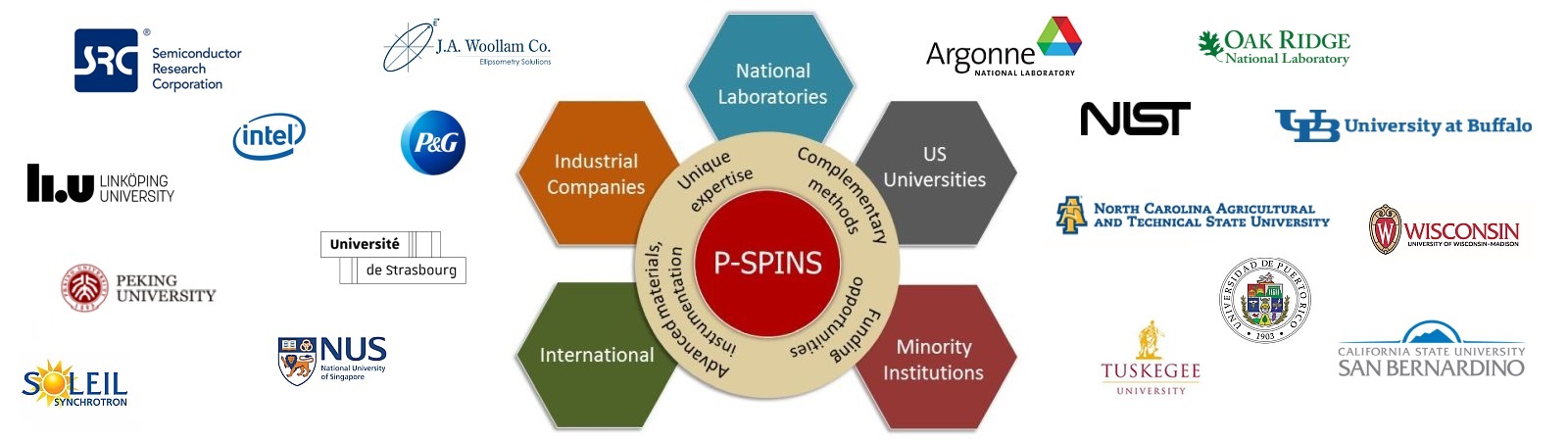
P-SPINS has established several long-term collaborations with industrial, national and academic research laboratories. Strategic partnership has been established with the Semiconductor Research Corporation (SRC) which involves leading electronics companies and promotes basic research to propel technology beyond its current limits. This industrial collaboration led to the launch of the multi-university Center for NanoFerroic Devices (CNFD) in 2013 (completed in 2017) and E2CDA Center (Energy-Efficient Computing: from Devices to Architectures) in 2017, both aimed at developing non-conventional, low-energy technologies. P-SPINS collaborates with these centers by providing fundamental understanding of materials properties, interacting with industrial liaisons, and participating in the annual reviews. All these strengthen P-SPINS’ partnerships with SRC.
To facilitate new partnerships, in 2016, a MRSEC/Industry Workshop “Nanoscience meets Industry" was organized, focusing on ongoing and developing research collaborations between industrial and university scientists. The Workshop was extremely successful providing a stimulating forum for recent research and technological developments, fostering interactions of MRSEC researchers with industry, and helping to leverage grant support for MRSEC.
Nebraska MRSEC has numerous partners at National Laboratories and U.S. universities. Examples of the on-going collaborative projects include the Center for Nanoscale Materials and Electron Microscopy Center at Argonne, Nanophase Materials Sciences at Oak Ridge, the National Institute of Standards and Technology (NIST), California State University-San Bernardino, University of Puerto Rico – Humacao and Río Piedras, Tuskegee University, and North Carolina A&T State University.
Highlights
- Nebraska MRSEC is pleased to announce that it has formed a partnership with Tuskegee University. The new initiative is funded by the NSF's Partnerships for Research and Education in Materials (PREM) program and seeks to broaden participation and increase diversity in materials research and education. (Aug. 2018)
- Ferroelectric Domain Wall as a Memristor
- Decoupling of Magnetization and Electric Polarization in Hexagonal Ferrites
- Trap Passivation to Enhance Solar Cell Efficiency
- Nebraska MRSEC Strengthens International Partnerships
International Collaborations
Major international collaborations exist with the Freie Universität Berlin, Germany; Physikalisch-Technische Bundesanstalt, Germany; Linköping University, Sweden; National University of Singapore; Helmholtz-Zentrum and IFW Dresden, Germany; Indian Institute of Technology - Kanpur, India; and the Canadian Light Source.